
In the heart of Pakistan’s villages and small towns, a different kind of technological revolution is taking place At Hadi Tech we believe that true innovation isn’t about how much money you spend, but how effectively you solve a problem.
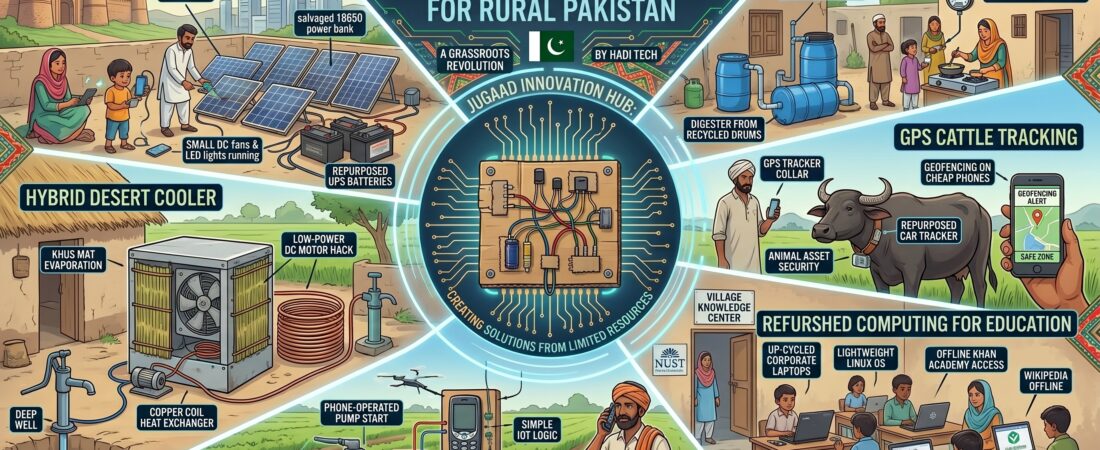
DIY Solar Power Revolution
Electricity remains one of the biggest challenges in rural areas. While high-end solar systems are expensive, middle-class families are now “inventing” their own modular power solutions. By repurposing old UPS batteries and using locally assembled DC-fans and LED lights, villagers are creating 12V ecosystems that bypass the need for expensive inverters.
The real tech “hack” here is the integration of salvaged laptop batteries (18650 cells) into portable power banks that can run lights and charge mobile phones for days. This “recycled energy” approach is making tech accessible to those who previously lived in the dark.
Smart Irrigation
Water scarcity is a major issue for small-scale farmers. Instead of buying million-rupee automated systems, rural innovators are using simple IoT (Internet of Things) logic with basic components. By using affordable “Float Switches” and basic timers connected to water pumps, farmers have invented auto-cutoff systems that prevent water wastage and save electricity.
Some have even gone a step further by using old mobile phones as “Remote Starters.” By simply calling a phone connected to a relay circuit, a farmer can turn his tube well on or off from miles away, saving hours of travel and fuel.
Evaporative Cooling
In the scorching heat of rural Punjab and Sindh, expensive AC units are not an option for the middle class. The “Jugaad” answer? The Hybrid Desert Cooler. By using a combination of traditional “Khus” mats and small high-speed DC motors, locals have optimized the airflow to drop room temperatures significantly with minimal power consumption.
The tech upgrade involves adding a simple copper-coil heat exchanger behind the fan, connected to a deep-well water source. This creates a “Natural AC” effect that consumes less electricity than a single light bulb. At Hadi Tech, we see this as a masterpiece of thermal engineering at a fraction of the cost.
Affordable Tech
For a villager, their cattle are their biggest asset. To prevent theft and monitor health, young tech-enthusiasts in villages are repurposing cheap GPS trackers designed for cars and fitting them into customized leather collars for livestock.
Furthermore, simple “Geofencing” apps on affordable smartphones allow farmers to receive an alert if their buffalo or cow moves outside a designated “safe zone.” This is high-end security tech adapted for the grassroots level, providing peace of mind to the middle-class farmer.
5. Education
Internet access is growing, but hardware is still expensive. The rural tech movement involves “Refurbished Computing.” Local shops are now specialized in taking old, discarded corporate laptops and “up-cycling” them with lightweight Linux-based operating systems.
These machines, which would otherwise be e-waste, are being turned into powerful educational tools for village children. By pre-loading them with offline Wikipedia and Khan Academy content, these “Jugaad Laptops” are bridging the digital divide without needing a high-speed fiber connection.
6.Turning Waste into Wireless Energy
In many villages, fuel for cooking is expensive. The “Tech Jugaad” here is the small-scale Bio-Gas digester made from recycled plastic drums and PVC piping. By using a basic understanding of anaerobic digestion, families are producing their own cooking gas and organic fertilizer from animal waste.
The modern twist? Integrating digital pressure gauges (bought for a few hundred rupees) to monitor gas levels, ensuring the system is safe and efficient. This is a perfect example of a circular economy where tech helps a household become self-sufficient.
Jugaad
The word “Jugaad” is often used to describe a temporary fix, but in the tech world, it represents Agile Innovation. It is about being smart with what you have. For the middle-class audience of Hadi Tech, these inventions are proof that you don’t need to wait for a government project or a foreign brand to improve your life.
When we look at a village boy fixing a solar panel with a piece of scrap wire, we aren’t just seeing a repair; we are seeing the spirit of an engineer. As we continue to document these rural tech hacks, we hope to inspire more people to look at the “waste” around them as the raw material for the next big invention.
Conclusion: Empowering the Grassroots
Technology belongs to everyone—not just those in big cities. From smart irrigation to repurposed education tools, rural Pakistan is proving that tech is a mindset, not a price tag. At Hadi Tech, we salute these silent inventors who are building the future of our country, one “Jugaad” at a time.
Stay curious, stay local, and keep inventing.