
So far, we’ve covered DIY energy systems and smart farming. But as the mercury rises across the plains of Pakistan, there is one question every Hadi Tech reader asks: How can I keep my room cool without a 100,000 PKR electricity bill?
1. The Physics of the “Chiller” Cooler
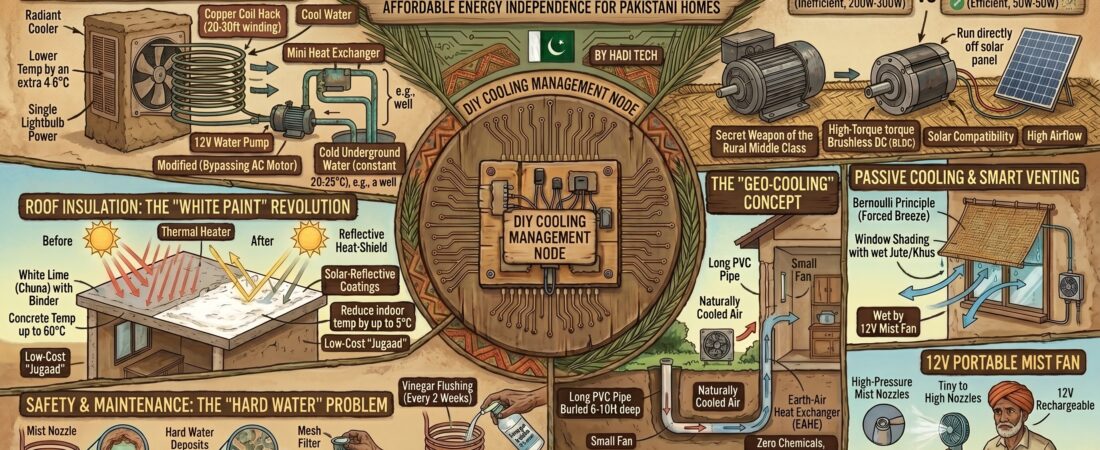
Most Pakistani households use a “Desert Cooler” (Lahori Cooler). While effective, they often struggle when the humidity rises. The grassroots innovation here is the Copper Coil Hack.
By winding a 20-to-30 foot copper pipe behind the fan blades of a standard cooler and connecting it to a small 12V water pump, you create a mini heat-exchanger. If you circulate cold underground water (which stays at a constant 20-25°C) through these coils, the air passing through is instantly chilled.
- The Science: This moves away from just “evaporation” and enters the territory of “radiant cooling.”
- The Benefit: It lowers the room temperature by an extra 4-6°C compared to a standard cooler, all while running on the power of a single lightbulb.
Maximizing Airflow
Standard AC-powered fans in coolers are often inefficient and loud. Local “Jugaad” experts are now replacing these with high-torque Brushless DC (BLDC) motors.
- Efficiency: A standard cooler motor consumes about 200W-300W. A high-end DC motor can provide the same airflow at just 50W-80W.
- Solar Compatibility: This allows you to run your entire cooling system directly off a single solar panel during the peak heat of the day—exactly when you need it most. At Hadi Tech, we consider the BLDC motor the “Secret Weapon” of the rural middle class.
The “White Paint” Revolution
Tech isn’t always electronic; sometimes it’s chemical. One of the most effective cooling “hacks” is reducing the thermal load on your roof. Concrete roofs in Pakistan can reach 60°C, acting like a giant heater for the rooms below.
The low-cost solution? Reflective Heat-Shield Paint. By mixing cheap white lime (Chuna) with a binding agent or using specialized solar-reflective coatings, you can reflect up to 80% of sunlight. This simple “invention” can reduce the indoor temperature by up to 5°C. It’s a one-time investment that pays for itself in comfort within days.
The “Geo-Cooling” Concept
In many rural areas, people are experimenting with Earth-Air Heat Exchangers (EAHE). This involves burying a long PVC pipe about 6 to 10 feet underground, where the earth’s temperature remains cool year-round.
- How it works: A small fan pushes hot outside air through the underground pipe.
- The Result: By the time the air reaches the other side and enters the room, it has naturally cooled down to the earth’s temperature. It is literally “Natural AC” with zero chemical refrigerants and almost zero electricity cost.
The Bernoulli Principle
Middle-class innovators are also using “Passive Cooling” techniques based on the Bernoulli Principle. By creating small, high-pressure inlets and large, low-pressure outlets (using different window opening sizes), you can force a natural breeze through a house even on a still day.
Combining this with “Window Shading”—using wet jute mats (Bori) or traditional Khus—allows you to use the wind to your advantage. This is ancient wisdom upgraded with modern airflow understanding.
The 12V Portable Mist Fan
For those who work outdoors or in workshops, the Portable Mist Fan is a life-saver. By attaching a tiny high-pressure misting nozzle (often used in gardening) to a 12V rechargeable fan, you create a personal cooling zone. As the tiny water droplets evaporate instantly in the heat, they suck the thermal energy out of the air, creating a “cool mist” effect that makes working in a garage or field bearable.
The “Hard Water” Problem
The biggest enemy of these DIY cooling systems in Pakistan is Scale (Khaara Paani). Hard water deposits can clog copper coils and misting nozzles.
- Hadi Tech Tip: Always use a simple mesh filter at the pump inlet. Every two weeks, circulate a mixture of vinegar and water through your copper coils to dissolve any calcium buildup. This keeps your “Jugaad” running at 100% efficiency all summer long.
Conclusion: Engineering Your Own Comfort
Week 3 has proven that you don’t need a 2-ton inverter AC to survive a Pakistani summer. By understanding how heat moves, you can engineer your own solutions using scrap copper, DC motors, and even the earth itself.
At Hadi Tech, we want to see a future where every home is a lab for thermal efficiency. These hacks don’t just save money; they reduce the load on our national grid and make us more resilient against climate change.