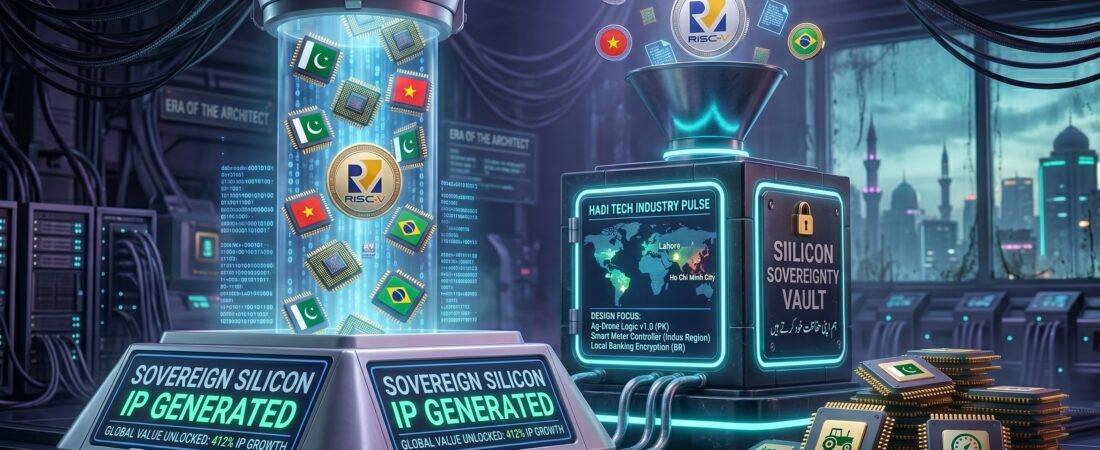
Let’s be honest for a second. For the last thirty years, we’ve been told a very specific story about technology: the “Big Boys” (the US, China, and Taiwan) build the hardware, and the rest of the world—countries like Pakistan, Vietnam, or Brazil—should just be happy to use it. We were the consumers. We were the “end-users.” If Intel made a chip, we bought it. If Apple designed a processor, we queued up for it. But something shifted recently. The pandemic, the global supply chain collapse, and the sudden realization that “he who owns the silicon, owns the future” has sparked a quiet revolution in smaller nations.
At Hadi Tech, I’ve been tracking this closely, and trust me: the move toward Silicon Sovereignty is the most aggressive and exciting thing happening in tech right now
The Myth of the “Untouchable” Chip
For a long time, chip design was seen as a “black art.” People thought you needed ten PhDs and a billion-dollar laboratory just to think about designing a microprocessor. And to be fair, if you were trying to compete with NVIDIA or Intel, that was true. But the world has changed. Technology has moved away from “general-purpose” computing to “specialized” computing.
Smaller countries have realized they don’t need to build a chip that runs a supercomputer. They need chips that solve their problems. They need chips for smart electricity meters that don’t fry during a power surge. They need low-power processors for agricultural drones that can fly over the Indus plains in 50-degree heat. This realization has broken the myth that chip design is only for the giants.
The Great Equalizer
If you want to understand why this is happening now, you need to know about RISC-V. In the past, if a local startup in a place like Lahore or Ho Chi Minh City wanted to design a chip, they had to go to a massive company like ARM and pay millions of dollars just for the license to start. It was a gated community, and the entry fee was too high.
Then came RISC-V. Think of it as the “Linux” of the hardware world. It’s an open-source architecture. It means the blueprints for how a chip “thinks” are free for everyone. This changed the game overnight. Suddenly, a group of four or five smart engineers in a small office can sit down, take the RISC-V architecture, and customize it to their heart’s content. They can add specific instructions for AI, or for security, or for extreme power efficiency.
This is where smaller nations are outsmarting the giants. While the big companies are trying to make one chip that fits everyone, local engineers in emerging markets are making “bespoke” silicon—chips that are tailor-made for local environments.
Why “Small” is the New “Big”
You might ask, “Why bother? Why not just buy a cheap chip from China?” The answer is Security and Survival. When a country relies entirely on imported silicon, they are vulnerable. We’ve seen how trade wars and sanctions can cripple an entire industry overnight.
Smaller nations are realizing that silicon is the new oil. If you don’t have your own supply—or at least the ability to design your own—you don’t truly have a sovereign tech industry. I’ve spoken to developers who are working on indigenous chips for local defense, for local banking, and for local healthcare. They aren’t doing it because it’s easy; they are doing it because it’s necessary.
Moreover, there is the “Intelligence” factor. When you design the chip yourself, you can bake in your own encryption. You can ensure there are no “backdoors.” For a country’s national security, that is priceless.
The Economic Ripple Effect
Let’s talk about the money, because at the end of the day, that’s what fuels innovation. When a country starts designing its own chips, it creates a massive high-value job market. We aren’t talking about call centers or basic software troubleshooting anymore. We are talking about VLSI (Very Large Scale Integration) engineers, logic designers, and verification experts.
These are the highest-paying jobs in the tech world. By training our youth in chip design, we are moving up the “value chain.” Instead of exporting raw talent, we are exporting intellectual property. A single chip design, licensed globally, can bring in more revenue than an entire year of textile exports. This is how “smaller” countries become “wealthy” countries.
The Printing Problem
Now, I won’t lie to you and say it’s all sunshine and rainbows. There is one massive hurdle: The Foundry. While we can design the chips here, we still can’t print them. Building a fabrication plant (a Fab) costs upwards of 10 to 20 billion dollars. That is still out of reach for most emerging economies.
But here’s the clever part: You don’t need to own the printer to own the book. Smaller nations are designing the chips locally and then sending those designs to global foundries (like TSMC or GlobalFoundries) to be printed. This “Fab-less” model is exactly how giants like Qualcomm and Apple operate. It allows us to focus on the “brain work” without the crippling debt of building a factory.
The Future belongs to the Architects
As I sit here writing this for Hadi Tech, I feel a sense of pride. I see young Pakistani engineers on GitHub contributing to the RISC-V ecosystem. I see startups in Vietnam raising millions for AI-accelerator chips. The walls are coming down.
The era of being just a “user” is over. We are entering the era of the Architect. Whether it’s a chip that manages a solar grid or one that powers a local EV, the silicon of the future will have the fingerprints of engineers from all over the world, not just Silicon Valley.
This isn’t just about technology; it’s about dignity. It’s about standing on our own feet and saying, “We know how this works, and we can do it better for ourselves.