
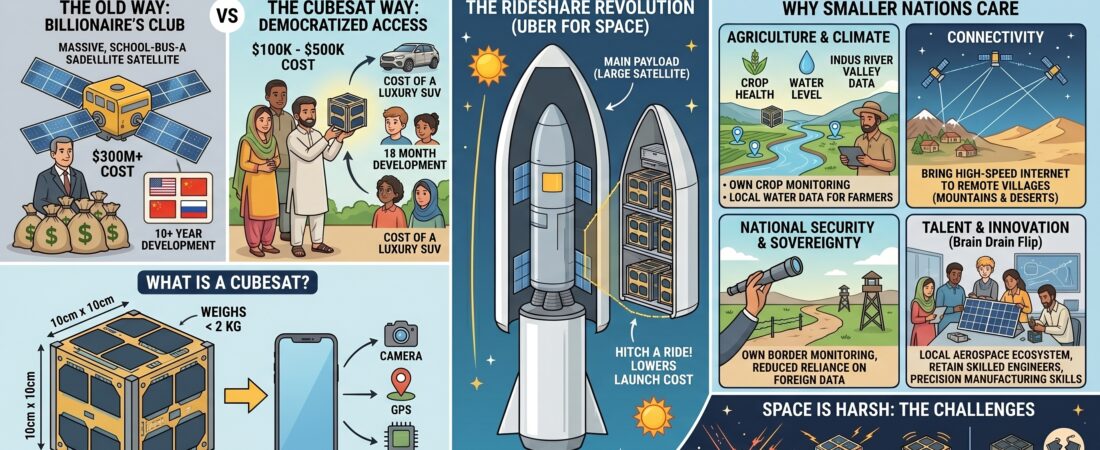
If you had told me ten years ago that a small group of university students in a country like Pakistan or Vietnam could launch their own satellite into orbit for the price of a luxury SUV, I would have laughed. Back then, space was the playground of superpowers—the US, Russia, China. It was a “Billionaire’s Club” where the entry fee was a decade of research and a national budget that could make your eyes water.
But as I’ve been tracking for Hadi Tech, that wall hasn’t just been cracked; it’s been demolished. We are currently living through the “CubeSat Revolution,” and it’s changing the destiny of smaller nations faster than anyone expected.
What is a CubeSat And why should you care
A CubeSat is exactly what it sounds like: a cube-shaped satellite. The standard unit, known as a “1U,” is just 10x10x10 centimeters—about the size of a large tissue box. It weighs less than two kilograms.
Now, you might think, “What can something that small actually do?” Twenty years ago, the answer was “not much.” But thanks to the smartphone revolution, we’ve learned how to cram incredible power into tiny spaces. The same high-resolution cameras, GPS sensors, and powerful processors that sit in your pocket are now being used to power these miniature satellites.
For a smaller country, this is the ultimate “Space Hack.” Instead of building a massive, school-bus-sized satellite that costs $300 million and takes 10 years to build, you can build a CubeSat for $100,000 to $500,000 in just 18 months.
The Rideshare Revolution
The biggest hurdle to space was always the rocket. Launching a dedicated rocket is expensive. But companies like SpaceX and various Indian and European agencies now offer “Rideshare” programs. Think of it like an Uber for space.
A massive rocket carrying a primary satellite often has leftover “dead space.” Launch providers sell this extra room to CubeSat builders for a fraction of the cost. You “hitch a ride” to orbit. This has lowered the barrier to entry so much that even middle-class-funded startups and local universities are now technically “Space Agencies.”
Why Smaller Nations are Racing for Orbit
You might wonder why a country struggling with inflation or infrastructure should care about space. The answer isn’t “prestige”—it’s Data Sovereignty.
- Agriculture & Climate: In countries like Pakistan, where the economy depends on the Indus River, having your own satellite means you don’t have to buy expensive imagery from foreign companies to monitor crop health or water levels. You have your own “eye in the sky” that passes over your specific province every 90 minutes, giving you real-time data on drought or floods.
- Connectivity: For nations with rugged mountains or vast deserts where laying fiber-optic cable is impossible, constellations of small satellites are the only way to bring high-speed internet to the most remote villages.
- National Security: Having your own monitoring capability means you aren’t reliant on the “kindness” of bigger nations to tell you what’s happening at your borders. It’s about not being blind in a digital world.
The “Brain Drain” Flip
One of the most beautiful things about the CubeSat movement is what it does for a country’s talent. For decades, the smartest aerospace engineers from emerging nations had to move to Europe or America to work. There was simply nothing for them to do at home.
Now, I’m seeing labs in places like Istanbul, Nairobi, and Karachi where young engineers are actually building flight hardware. They are writing the code for attitude control systems and testing solar panel deployments. This creates a “Space Ecosystem” locally. When you build a satellite, you aren’t just putting metal in orbit; you are building a workforce that understands high-stakes engineering, precision manufacturing, and complex data analysis. These skills then “leak” into other industries, making the whole country smarter.
Space is Still Hard
I don’t want to make it sound like a walk in the park. Space is a brutal environment. You have extreme temperature swings (from -120°C to +120°C in a single orbit), vacuum conditions, and cosmic radiation that can fry a standard chip in seconds.
Many first-time CubeSats fail. They become “space junk” because a single soldering joint cracked during the vibration of the launch or a software bug prevented the antenna from unfolding. But here’s the thing: because they are so cheap, you can afford to fail. In the old days, a satellite failure was a national disaster. Today, it’s a “learning experience” on the way to the next launch.
My Take: Reclaiming the Sky
At Hadi Tech, I’ve always believed that technology is the great equalizer—but only if you have the guts to grab it. The CubeSat revolution is giving smaller nations a seat at the table. It’s moving us from being “observers” of the space race to being “participants.”
We are moving toward a future where “The Space Agency of Pakistan” or “The Vietnamese Space Program” isn’t a punchline for a joke—it’s a high-tech powerhouse providing critical data for local farmers, local soldiers, and local teachers.
The sky used to be the limit. Now, for the price of a small house, the sky is just the beginning.