“The Grassroots Tech Revolution.” At Hadi Tech, we believe that the most powerful innovations aren’t always the most expensive ones. In a country where energy instability and rising costs are a daily reality, the ability to generate and manage your own power
Decentralized Power
For too long, we have relied on a massive, centralized grid that is prone to failure and rising tariffs. The grassroots revolution is about moving toward decentralized power. This doesn’t mean buying a million-rupee solar setup. Instead, it involves understanding the basics of DC (Direct Current) electricity and utilizing repurposed materials to create a “Personal Power Plant.”
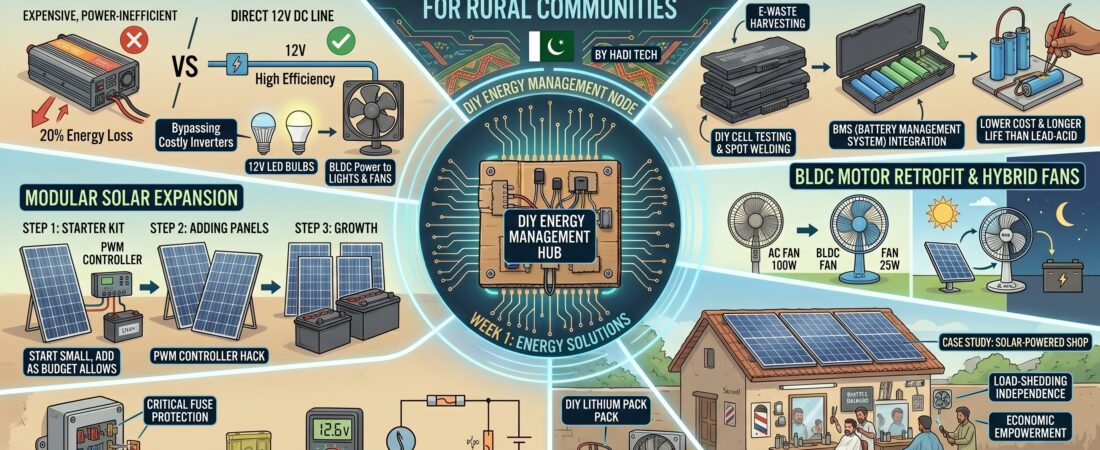
By focusing on 12V systems, inventors in small towns are bypassing the need for expensive inverters, which often lose 20% of energy during the conversion from DC to AC. A direct 12V line from a battery to an LED bulb or a DC fan is far more efficient and significantly cheaper to maintain.
Repurposing the “Dead” – The Lithium-Ion Hack
One of the most impressive inventions coming out of local workshops is the restoration of lithium-ion cells. Most discarded laptop batteries still contain several healthy 18650 cells. Tech-savvy individuals are harvesting these cells, testing their voltage, and spot-welding them into “Power Walls.”
These DIY battery packs are much lighter, more efficient, and longer-lasting than traditional lead-acid or deep-cycle batteries. When paired with a basic BMS (Battery Management System)—which costs only a few hundred rupees—these repurposed batteries can power an entire room’s lighting and charging needs for a fraction of the cost of a new battery. This is circular tech at its finest: reducing e-waste while solving a local energy crisis.
Buying in Stages
The biggest barrier to solar energy is the upfront cost. However, the “Hadi Tech” approach promotes modularity. Middle-class innovators are starting with just a single 150W or 180W panel. Instead of waiting to buy a complete system, they connect this single panel directly to a 12V battery via a low-cost PWM (Pulse Width Modulation) controller.
This “Starter Kit” allows a family to run two fans and three lights throughout the night without ever touching the national grid. As their budget grows, they can add more panels in parallel. This step-by-step investment strategy is how rural Pakistan is slowly turning its rooftops into miniature power stations.
The DC Fan Revolution
In the extreme heat of the Indus plains, a fan is a life-saving device. Standard AC fans consume about 80W to 100W of power. In contrast, modern brushless DC (BLDC) fans consume only 12W to 30W. By switching to DC fans, a rural household can triple the “runtime” of their battery.
We have seen incredible local modifications where traditional pedestal fans are gutted and fitted with high-torque DC motors. This “Hybrid Fan” allows the user to run the fan directly off a solar panel during the day and a small battery at night. It is simple, rugged, and perfectly suited for the harsh environment of a Pakistani village.
The Importance of Fuses and Gauges
One common mistake in “Jugaad Tech” is neglecting safety. Because these are DIY systems, there is a risk of short circuits. The grassroots revolution is now maturing, with more people realizing that a 10-rupee fuse can save a 10,000-rupee battery.
At Hadi Tech, we emphasize the use of simple digital voltmeters. These tiny, low-cost displays allow a user to monitor their battery’s health in real-time. Knowing when to stop using a battery (before it reaches a critical low voltage) can double the lifespan of the equipment. Information, in this case, is literally power.
The “Solar-Powered Shop”
Take the example of a small barber shop in a village near Sahiwal. By installing two repurposed panels and a DIY lithium pack, the shop owner no longer loses business during afternoon load-shedding. His trimmers, lights, and fans run on free energy. His “payback period” for the equipment was less than six months, simply by the money saved on the electricity bill. This is economic empowerment through tech.
Scaling Local Innovations
The goal of this series is to inspire you to look at tech differently. We don’t need to wait for massive international brands to bring us solutions. The components are already here—in our scrap markets, in our local hardware stores, and in our collective ingenuity.
By sharing these “Energy Hacks,” we hope to create a community where knowledge is shared freely. If one person learns how to build a 12V lighting system, they can teach ten others in their neighborhood. This is how a grassroots revolution spreads.
Conclusion: Your Journey to Independence
Week 1 has shown us that energy independence is within reach of the middle class. It requires a bit of curiosity, a small investment in basic components, and the willingness to experiment. As we continue this series at Hadi Tech, we will move from power to other vital areas like agriculture, water, and communication.