
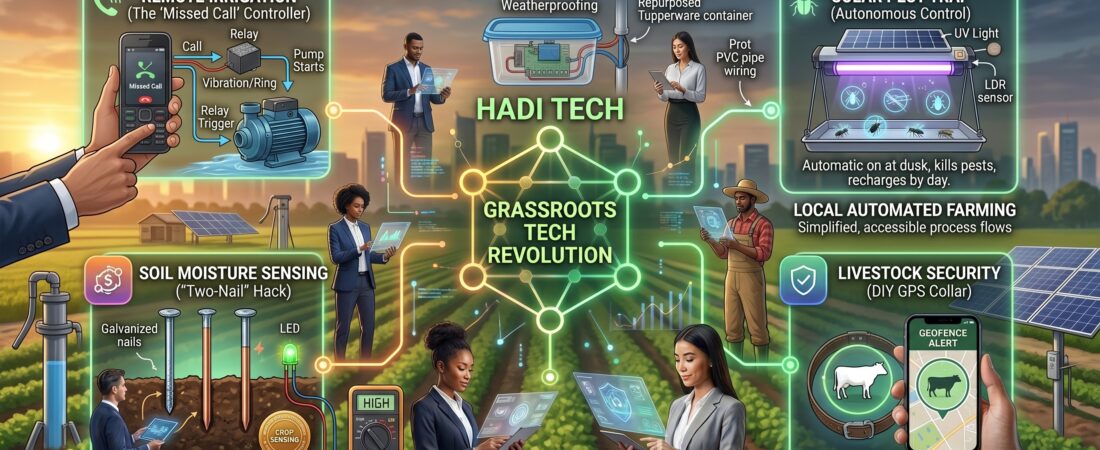
At Hadi Tech, we recognize that the backbone of Pakistan is its agriculture, yet the “Smart Farming” tools sold by global corporations are often priced far out of reach for the average middle-class farmer.
The Problem: Water Waste and Manual Labor
In many villages across Pakistan, irrigation is a game of timing and luck. Farmers often have to walk miles in the middle of the night to turn on a tube-well or wait hours for a water turn (Warabandi), only to realize the soil was already saturated. This leads to two major issues: the waste of precious groundwater and the unnecessary consumption of expensive electricity or diesel.
The “Grassroots” solution isn’t a million-dollar satellite system. It is a Remote Pump Controller made from a discarded mobile phone.
Remote Irrigation
One of the most brilliant “Jugaad” inventions used by local farmers involves a basic relay circuit connected to a cheap, secondary mobile phone. By wiring the phone’s vibration motor or speaker output to a high-voltage relay, a farmer can trigger his water pump simply by calling the number of that phone.
- The Logic: A call comes in $\rightarrow$ The phone vibrates/rings $\rightarrow$ The electrical signal triggers the relay $\rightarrow$ The pump starts.
- The Benefit: No more traveling to the field at 2:00 AM. If the electricity goes out, the farmer gets a notification when the phone loses its charging signal, letting him know the pump has stopped.
This simple hack costs less than 2,000 PKR to assemble but saves hundreds of hours of manual labor and thousands of rupees in fuel costs every year.
The Two-Nail Hack
High-end moisture sensors can be expensive, but the physics of soil moisture is simple: wet soil conducts electricity better than dry soil. Rural innovators have started using “Conductivity Probes” made from two long, galvanized nails or copper rods.
By connecting these rods to a basic multimeter or a low-cost LED indicator circuit, a farmer can get a “Readout” of the soil’s thirst.
- Low Resistance (High Light/Reading): The soil is wet; no need to water.
- High Resistance (Low Light/Reading): The soil is dry; it’s time to irrigate.
The GPS Collar
For a middle-class family in a village, a cow or a buffalo is more than just an animal; it is a significant financial investment. Livestock theft is a constant worry. The grassroots answer to this is the DIY GPS Collar.
By purchasing a generic vehicle GPS tracker (widely available in local electronics markets) and sewing it into a heavy-duty leather collar, owners can set up a “Geofence” via a free mobile app. If the animal moves more than 500 meters away from the farm, the owner receives an instant alert on their phone. This is high-end security tech adapted for the protection of rural assets.
The Solar Light Trap
Instead of relying solely on expensive and harmful chemical pesticides, many small-scale farmers are returning to an automated version of a classic technique: the Solar-Powered Light Trap.
By mounting a UV (Ultraviolet) or bright LED light over a shallow tray of water mixed with a bit of kerosene, farmers can capture thousands of harmful insects overnight. By adding a small solar panel and a light-sensitive switch (LDR), the trap becomes completely autonomous. It turns on at dusk, kills pests all night, and recharges its battery during the day. This reduces the “Chemical Load” on the crops and keeps the farmer’s expenses low.
Accessing Real-Time Data
Technology isn’t just about hardware; it’s about information. The middle-class tech revolution includes the use of “Weather and Price Apps” on basic Android phones. By monitoring the Arat (Market) prices in nearby cities like Lahore, Multan, or Faisalabad in real-time, farmers can decide the best day to harvest and sell their produce.
This prevents the “Middleman Trap,” where local buyers take advantage of a farmer’s lack of information. Knowledge is the ultimate tool for financial survival in the village.
Weatherproofing Your Tech
One of the biggest challenges of “Agri-Tech” is the environment. Dust, humidity, and extreme heat can destroy electronics. The “Jugaad” way to protect these devices is using repurposed materials:
- Old Tupperware Boxes: Perfect for housing circuits and keeping them waterproof.
- PVC Pipes: Excellent for protecting wiring from rodents and tractors.
- Reflective Tape: Used on sensors to prevent them from overheating under the direct Pakistani sun.
Conclusion: The Farmer as an Engineer
Week 2 has shown us that the gap between a traditional farmer and a tech-innovator is smaller than we think. You don’t need a degree in robotics to build a smart farm As we continue the “Grassroots Tech Revolution” series on Hadi Tech, we will keep exploring these intersections of tradition and technology. The goal is to build a Pakistan where every village is a hub of innovation.