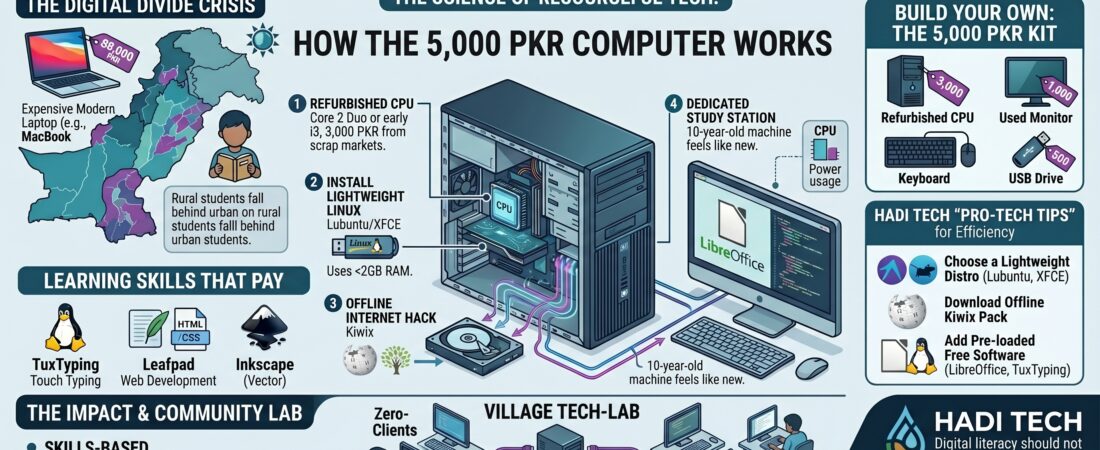
In the modern era, a computer is no longer a luxury; it is a gateway to the world’s knowledge. However, for a middle-class family in a Pakistani village, the price of a brand-new laptop—often exceeding 80,000 PKR—is an impossible barrier. This financial gap creates a “Digital Divide,” where rural children stay behind while city kids move ahead.
At Hadi Tech, we refuse to accept this. This week, we introduce “The 5,000 Rupee Computer.” We are showing you how to repurpose old, discarded hardware and use “Lightweight Tech” to create a powerful learning machine that can teach coding, graphic design, and freelancing to any student, regardless of their budget.
Refurbished Corporate Hardware
Every year, thousands of offices in cities like Karachi, Lahore, and Islamabad upgrade their systems. Their “old” CPUs (like Core 2 Duo or early i3 systems) are sold into the scrap market for as low as 3,000 to 5,000 PKR. While these machines might seem “slow” for modern gaming, they are goldmines for education if handled correctly.
The hardware isn’t the problem; the software is. Most people try to run heavy, modern versions of Windows on old hardware, which causes it to lag. At Hadi Tech, we change the game by switching the “Engine.”
Lightweight Linux
The first step in the 5,000 Rupee Computer is removing Windows and installing a “Lightweight Linux Distribution” (like Lubuntu or XFCE).
- Speed: These operating systems are designed to run on very low RAM (even 2GB).
- Cost: They are 100% free. You don’t have to pay for licenses or crack versions.
- Utility: They come pre-loaded with “LibreOffice” (a free alternative to Microsoft Word, Excel, and PowerPoint) and coding tools like Python.
By switching to Linux, a 10-year-old machine starts to feel like a brand-new one. It becomes a dedicated “Study Station” where a student can learn without the distractions of heavy software.
Knowledge Without Data
Internet in rural Pakistan can be expensive and unstable. How does a child research for a school project without a 4G connection? The answer is Kiwix.
Kiwix is a “Jugaad” tool that allows you to download the entirety of Wikipedia, Khan Academy, and thousands of Project Gutenberg books onto a simple USB drive or the computer’s hard drive.
- The Benefit: Once downloaded (which you can do once at a city net-cafe), the student has access to millions of articles and educational videos offline. No data, no signals, no monthly bills—just pure knowledge available 24/7.
From Typing to Coding
A 5,000 PKR computer is enough to start a career in freelancing. At Hadi Tech, we recommend focusing on these three “High-ROI” skills that run perfectly on low-end hardware:
- Touch Typing: Using free offline software like “TuxTyping,” kids can master typing speeds that make them eligible for data entry jobs.
- Web Development: HTML and CSS don’t require a fast PC. You only need a simple text editor (like Leafpad) and a browser to build websites.
- Graphic Design (Vector): Using “Inkscape” (a free, lightweight alternative to Adobe Illustrator), students can learn to design logos and social media posts.
The Village Tech-Lab
Imagine if five families in a street combined their resources to buy one “High-End” refurbished server for 10,000 PKR and connected four “Zero-Clients” (cheap monitors and keyboards) to it. This is a “Multi-Seat” setup. One CPU powers four students simultaneously.
This “Village Tech-Lab” model is how we can bring an entire generation online. It’s about sharing resources and using “Jugaad” to bypass the high costs of individual ownership.
Conclusion: Empowering the Next Generation
Technology is the ultimate equalizer. A child in a village in Rajanpur has the same brain as a child in New York; they only lack the tools. The 5,000 Rupee Computer is not just a box of wires; it is a ladder.
At Hadi Tech, our mission is to show you that the “scrap” of the city is the “treasure” of the village. Don’t wait for a government laptop scheme. Take control, find an old CPU, install Linux, and start the digital revolution in your own home.