
At Hadi Tech, we believe that the solution to our biggest problems This week, we explore the Solar Water Distiller—a low-cost, high-impact that uses the heat of the sun to purify water, requiring zero electricity and zero expensive filters.
The Crisis of Groundwater in Pakistan
Before we dive into the technology, we must understand the “why.” In many Pakistani villages, the groundwater is “Khaara” (saline/brackish). While traditional filters (like RO plants) can fix this, they are expensive to install and even harder to maintain. When a membrane gets clogged in a village, the whole system often sits idle for months.
The Solar Distiller bypasses this entirely. It doesn’t use membranes or high-pressure pumps. Instead, it uses the natural process of evaporation—the same process that creates rain.
The Science of Evaporation
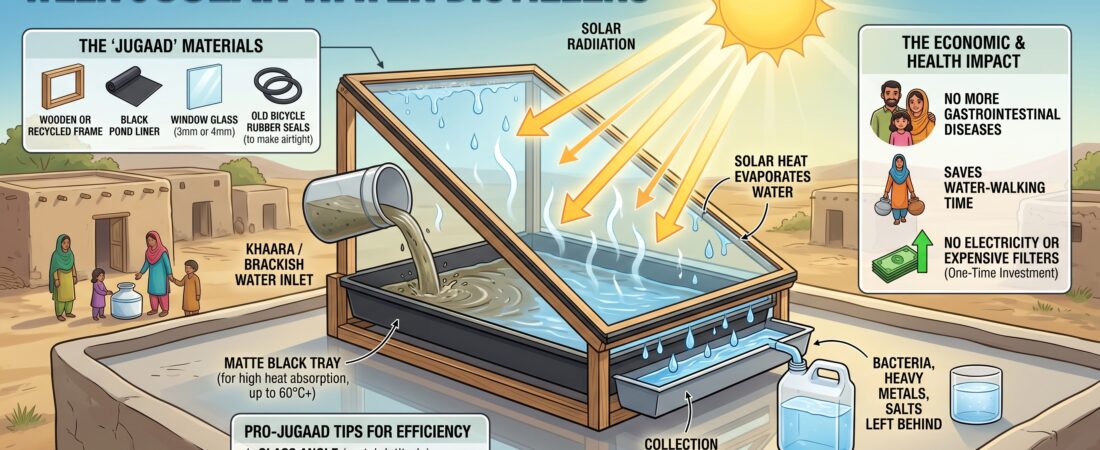
The Solar Distiller (also known as a Solar Still) is essentially a greenhouse for water. It consists of a shallow, airtight box with a transparent glass cover.
- Heat Absorption: The bottom of the box is painted matte black to absorb maximum solar radiation. Brackish or dirty water is poured into this tray.
- Evaporation: As the sun hits the box, the temperature inside rises significantly (up to 60°C or more). The water begins to evaporate, turning into pure water vapor.
- Purification: Crucially, only the water evaporates. Bacteria, viruses, heavy metals (like Arsenic), and salts stay behind in the tray because they cannot turn into vapor at these temperatures.
- Condensation: The vapor hits the cool glass roof of the box. Because the glass is slanted, the vapor turns back into liquid droplets (pure water) and trickles down into a clean collection trough.
The result is “Distilled Water”—water that is nearly 100% pure, free from salts and pathogens.
The “Jugaad” Materials
The beauty of this tech is that it can be built from materials found in any local market:
- The Box: Can be made from wood (lined with plastic) or recycled plastic drums.
- The Liner: A sheet of black pond liner or even a simple black-painted metal tray works best.
- The Roof: A simple piece of 3mm or 4mm window glass.
- The Seal: Old rubber tubes from cycles or simple silicone can be used to make the box airtight.
Making Every Drop Count
For a middle-class family, efficiency is key. To get the most water out of your distiller, Hadi Tech recommends these three “Pro-Jugaad” tips:
- Angle of the Glass: The glass should be tilted at an angle equal to your local latitude (usually between 24° to 34° in Pakistan) to catch the most sunlight.
- Airtight Construction: If air escapes, you lose vapor. Ensure the glass is sealed tightly against the frame.
- Pre-Heating: If you use a black-painted pipe to pre-heat the water before it enters the box, you can increase your daily yield by up to 25%.
The Economic and Health Impact
A single square meter of a solar still can produce 3 to 5 liters of water on a sunny day. While this may seem small, for a family in a remote village, it provides enough pure water for cooking and drinking for the most vulnerable members—children and the elderly.
Economically, this saves the family from medical bills related to waterborne diseases. It also saves the “water-walking” time often spent by women and children fetching water from distant clean sources.
The “Slurry” Removal
The only maintenance required is cleaning the bottom tray. Once or twice a week, you simply flush out the concentrated salt and dirt that stays behind. This ensures the black surface remains dark and continues to absorb heat effectively.
Conclusion: A Vision for Every Rooftop
At Hadi Tech, we envision a future where every rural home in Pakistan has a Solar Distiller on its roof. It is a one-time investment that pays back in the form of health and dignity. We don’t need massive pipelines from the cities; we need smart, decentralized solutions that empower the individual.
Pure water shouldn’t be a luxury for the few; with a little bit of glass and a lot of sunlight, it can be a reality for everyone.