
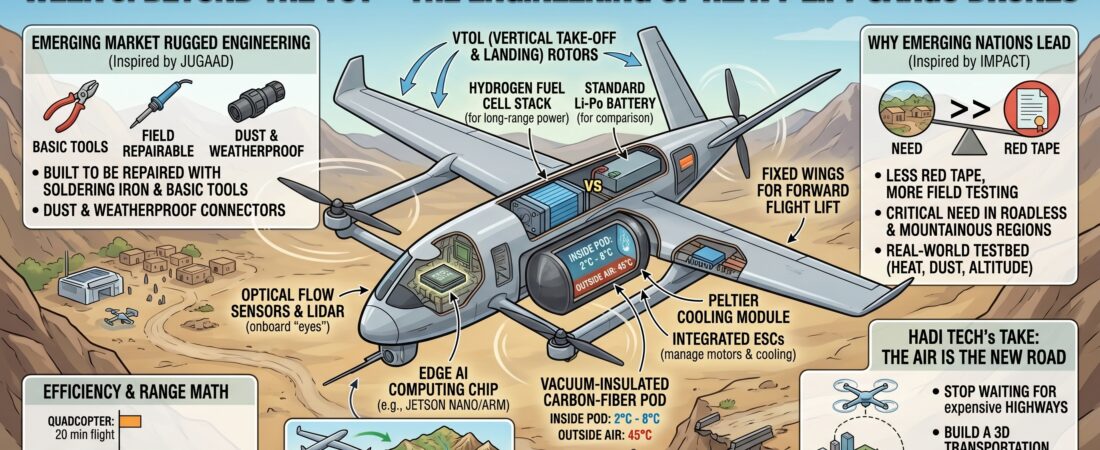
When most people see a drone, they think of a plastic quadcopter taking wedding photos. But in countries where the roads disappear during the monsoon or where mountains make a 10km trip take five hours, drones are being re-engineered into Aerial Freight Trains. At Hadi Tech, I’ve been looking at the specs of these machines, and the engineering shift from “consumer” to “industrial” is massive.
1. Fixed-Wing vs. Multirotor:
The drones we see at weddings (multirotors) are incredibly inefficient for long-distance travel. They spend most of their battery power just fighting gravity. For true logistics—delivering 10kg of medicine or 20kg of spare parts—emerging tech hubs are moving toward VTOL (Vertical Take-Off and Landing) Fixed-Wing designs.
These machines take off like a helicopter using four rotors, but once they reach altitude, a rear propeller kicks in, and they fly like an airplane using wings for lift.
- The Math: A standard quadcopter might stay up for 20 minutes. A VTOL fixed-wing can stay airborne for 2 hours on the same battery because wings provide “free lift” from the air.
2. Hydrogen vs. High-Density Lithium
The biggest “bottleneck” in drone tech for smaller countries is the battery. Standard Li-Po batteries are heavy and lose capacity in the extreme heat of South Asia or Africa.
We are seeing a move toward Hydrogen Fuel Cells for long-range cargo drones. Hydrogen has a much higher energy density than lithium. While a battery-powered drone might travel 50km, a hydrogen-powered drone can cover 200km+. For a country like Pakistan, this means you could connect an urban hospital in Multan to a remote clinic in the heart of the Cholistan desert in a single flight.
3. Edge Computing and “GPS-Denied” Navigation
In many remote areas, GPS signals are weak or can be jammed. Industrial drones can’t afford to get lost. The new wave of technology involves Visual Odometry and Edge AI.
Instead of relying on a satellite, the drone has onboard “eyes” (optical flow sensors and LiDAR). It builds a 3D map of the terrain in real-time as it flies. If it loses GPS, the onboard computer (like a Jetson Nano or an upgraded ARM chip) compares the ground features to its pre-loaded map to find its way home. This is high-level robotics being used for survival, not just show.
4. The “Cold Chain” Engineering
Delivering medicine or vaccines isn’t just about flying; it’s about thermodynamics. Cargo drones in emerging markets are now being fitted with Peltier Cooling Modules or vacuum-insulated carbon-fiber pods. These pods must maintain a steady 2°C to 8°C while the outside air is 45°C. This requires precise electronic speed controllers (ESCs) that can manage both the flight motors and the cooling system without draining the battery mid-flight.
5. Why Smaller Countries are Leading This
The US and Europe have crowded skies and strict regulations (FAA/EASA) that make testing cargo drones a legal nightmare. But in countries like Rwanda or the remote northern areas of Pakistan, the “Need” outweighs the “Red Tape.”
Engineers here are testing in real-world conditions—high altitudes, dust, and wind. They are building “Ruggedized Tech.” A drone that works in a clean lab in San Francisco might fail in the dust of a village, but a drone engineered in a local workshop is built to be repaired with a soldering iron and basic tools.
My Take: The Air is the New Road
At Hadi Tech, I believe we should stop waiting for expensive highways that take decades to build. The future of logistics for smaller nations is in the air. By mastering the flight controllers, the composite airframes, and the long-range telemetry, we aren’t just “playing” with drones—we are building a 3D transportation network that ignores the broken ground.