Pakistan’s tech narrative was confined to the boundaries of freelance software development and call centers From the bustling labs in NUST to the high-tech startups in Lahore’s Arfa Tower, a hardware and deep-tech revolution is brewing
The Rise of Agri-Tech: Intelligent Farming for the Indus Plains
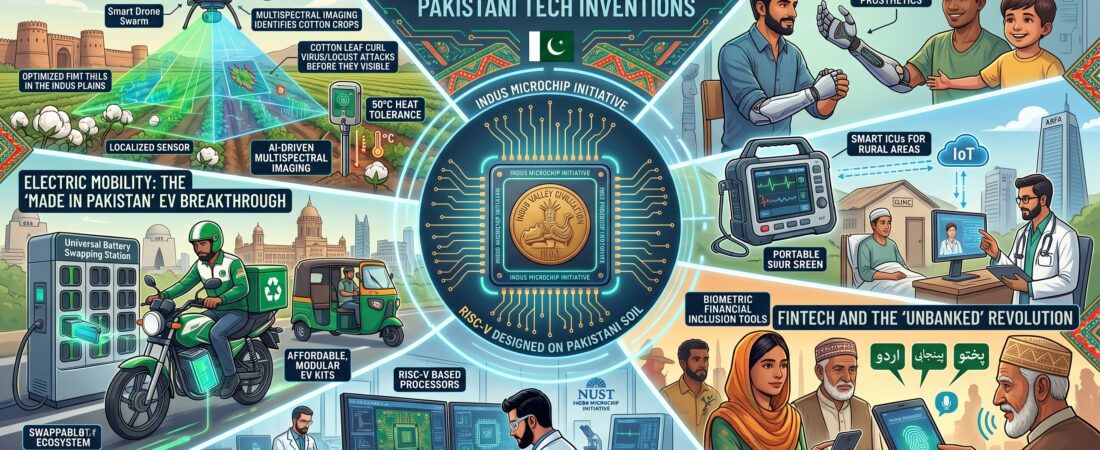
Pakistan is an agrarian economy, and the most impactful inventions are those solving the challenges of our soil. Local engineers have recently pioneered “Smart Drone Swarms” specifically calibrated for the unique atmospheric conditions of the Punjab and Sindh belts.
Unlike imported drones, these locally manufactured UAVs use AI-driven multispectral imaging to detect crop diseases (like the locust attacks or cotton leaf curl virus) weeks before they become visible to the human eye. By inventing localized sensors that can withstand the extreme 50°C heat of a Pakistani summer, these tech pioneers are saving billions in crop yields. This isn’t just a gadget; it’s a lifeline for the national economy.
Electric Mobility: The “Made in Pakistan” EV Breakthrough
The streets of Karachi and Islamabad are witnessing a silent transition. While global giants like Tesla dominate the West, Pakistani startups have invented affordable, modular Electric Vehicle (EV) kits for two and three-wheelers.
The real invention here is the “Swappable Battery Ecosystem.” Local engineers realized that charging infrastructure is a hurdle, so they invented a universal battery docking station that works on a subscription model. This homegrown solution to the energy crisis is a masterclass in frugal engineering—taking advanced lithium-ion tech and adapting it to the rugged, high-traffic environment of Pakistani roads.
Med-Tech: Low-Cost Precision in Healthcare
Perhaps the most noble inventions are coming from the medical sector. Pakistani researchers have developed AI-powered prosthetic limbs that are significantly more affordable than their European counterparts.
Using 3D printing and locally developed neural-link software, these prosthetics allow users to control limb movement via muscle signals. Another breakthrough is the development of portable, low-cost “Smart ICUs” designed for rural areas. These devices use IoT (Internet of Things) to connect a patient in a remote village in Gilgit to a specialist in Karachi in real-time, providing diagnostic precision that was previously impossible.
FinTech and the “Unbanked” Revolution
While the world talks about Neo-banks, Pakistan has invented unique “Biometric Financial Inclusion” tools. In a country where a large portion of the population is not tech-savvy, local developers have created voice-activated, multi-lingual financial interfaces.
These platforms allow a farmer in a remote village to conduct secure transactions using only their thumbprint and voice commands in Urdu, Punjabi, or Pashto. By bypassing the need for traditional literacy, this tech invention is bringing millions into the formal economy, proving that the best tech is the one that is accessible to everyone.
Deep Tech: The Quest for Indigenous Semiconductor Design
The global chip shortage taught the world a lesson in self-reliance. In response, Pakistani academic circles and private firms have started the “Indus Microchip Initiative.” For the first time, we are seeing the design of RISC-V based processors on Pakistani soil.
While we aren’t at the stage of mass-manufacturing 3nm chips yet, the invention of specialized Integrated Circuits (ICs) for local industrial machinery is a massive step. This reduces our reliance on expensive imports and ensures that our industrial secrets stay within our borders.
The Challenges: Scaling the “Idea” into a “Product”
Every great invention faces the hurdle of the “Valley of Death”—the gap between a working prototype and a commercial product. For Pakistani inventors, the challenge isn’t a lack of brainpower; it’s the lack of venture capital and high-end manufacturing facilities.
However, the “Hadi Tech” perspective remains optimistic. With the government’s new Special Technology Zones (STZs) and a growing interest from overseas Pakistanis to invest in local R&D, the infrastructure is finally catching up with the ambition.
Why This Matters for the Youth
Technology is the ultimate equalizer. For the young readers of Hadi Tech, these inventions are a signal that you don’t need a Silicon Valley zip code to change the world. Whether it’s an AI that optimizes the national power grid to prevent blackouts or a solar-powered water filtration system for the Thar desert, the problems of Pakistan are providing the greatest opportunities for innovation.
Conclusion: A Tech-Forward Pakistan
The era of “Imported Tech” is slowly fading. The “Silicon Indus” is real, and it is built on the resilience and “Jugaad” of Pakistani engineers who have learned to innovate under pressure. As we document these breakthroughs at Hadi Tech