
Beyond the Hype: The Technical Reality of Global Shipping Chokepoints in 2026
When we talk about the “Strait of Hormuz” or the “Red Sea,” we aren’t talking about abstract concepts. We are talking about Supply Chain Engineering. In 2026, the world is facing a “Double Chokepoint” crisis that is changing how engineering and logistics work.
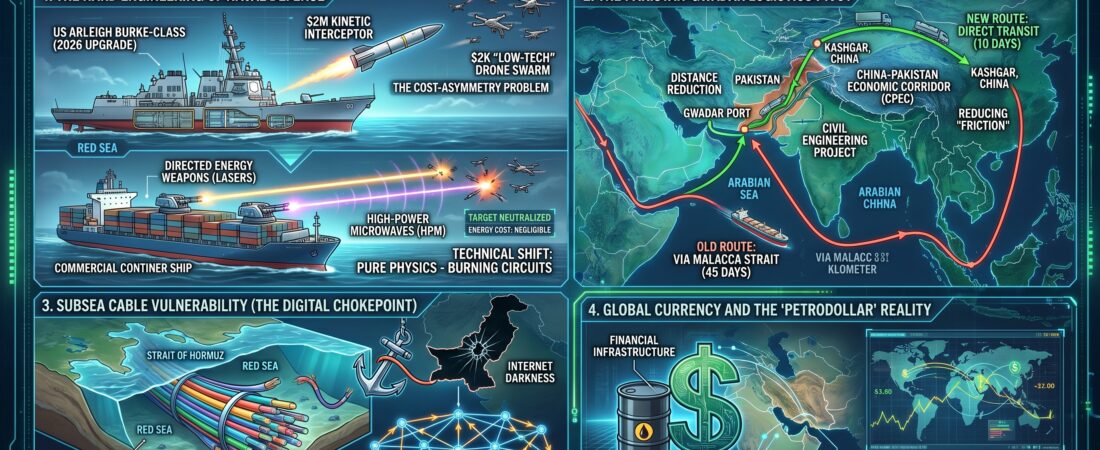
- The Hard Engineering of Naval Defense
In the Red Sea the technical challenge isn’t software it’s Kinetic Interception.
The Cost-Asymmetry Problem: Naval destroyers are using missiles that cost $2 million each to shoot down “low-tech” drones that cost only $2,000.
The Technical Shift: Engineers are now rushing to install Directed Energy Weapons (Lasers) and High-Power Microwaves (HPM) on commercial ships. This is pure physics—using light and electricity to burn out drone circuits instead of expensive explosives. - The Pakistan-Gwadar Logistics Pivot
Pakistan’s Gwadar Port is often discussed in politics, but the technical reality is about Distance Reduction.
The Route Math: Currently, goods traveling from the Persian Gulf to Western China must travel thousands of kilometers by sea through the Malacca Strait.
The Technical Fix: The “China-Pakistan Economic Corridor” (CPEC) is a massive Civil Engineering project. By moving oil via pipelines and trucks from Gwadar directly to Kashgar, the transit time drops from 45 days to just 10 days. This is about reducing “friction” in the global machine. - Subsea Cable Vulnerability (The Digital Chokepoint)
While everyone looks at the ships on the water, the real “Technical Nerve Center” is under the water.
Physical Infrastructure: The seabed near the Strait of Hormuz and the Red Sea is packed with Fiber Optic Cables. These cables carry 99% of all transcontinental data.
The Real Risk: If these physical glass fibers are cut by anchors or sabotage, the internet in entire regions (including Pakistan and parts of the Middle East) doesn’t just “slow down”—it goes dark. The technical focus in 2026 is on Subsea Mesh Networking, creating underwater “backups” that can reroute data instantly. - Global Currency and the “Petrodollar” Reality
Why does the US care so much about a small strip of water in the Middle East? It’s Financial Infrastructure.
The Mechanics: Most oil is traded in US Dollars. If the flow of oil through the Strait of Hormuz is blocked, the demand for dollars fluctuates wildly.
The Technical Impact: This causes Inflation Volatility. For a country like Pakistan, which pays for imports in dollars but earns in PKR, a 10% disruption in the Strait can lead to a 30% jump in local petrol prices within 48 hours. This is a hard economic link that no software can fix.